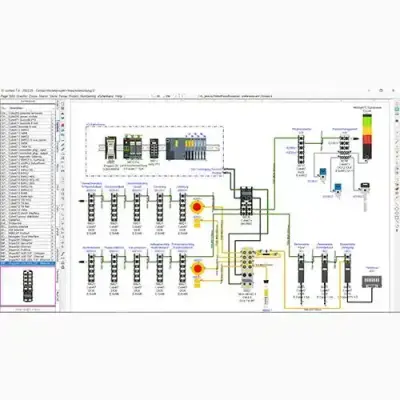
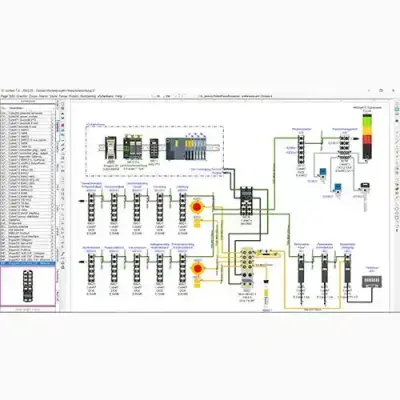
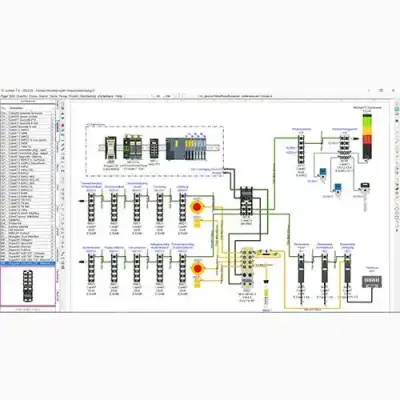
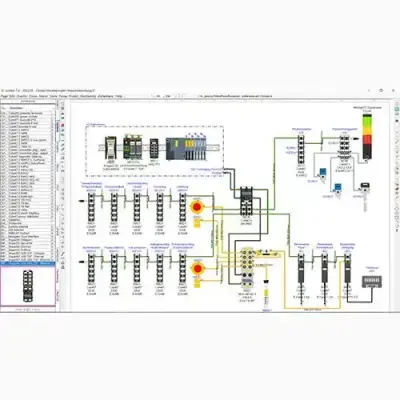
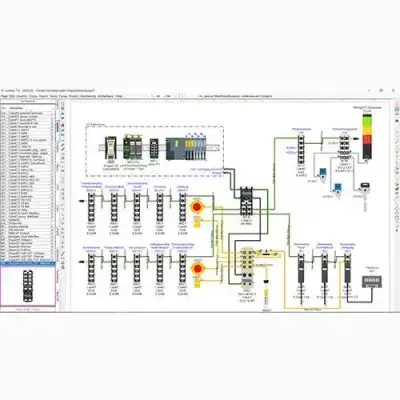
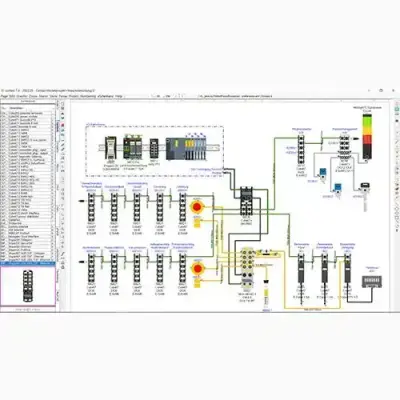
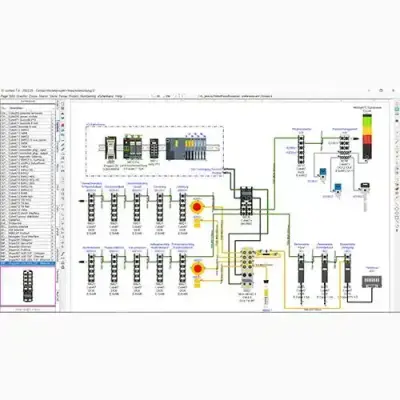
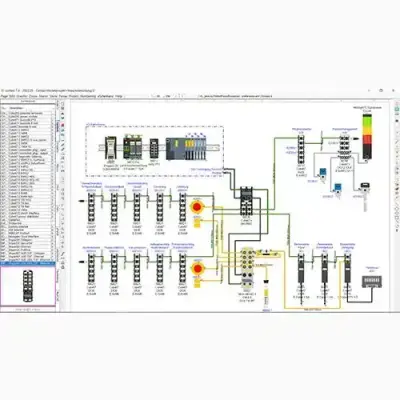
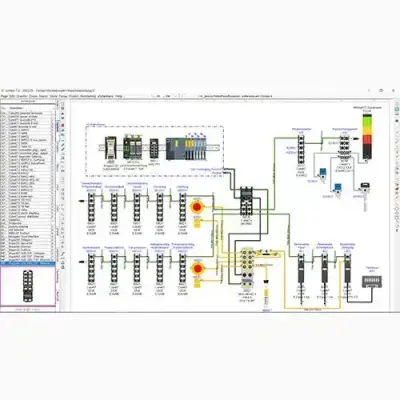
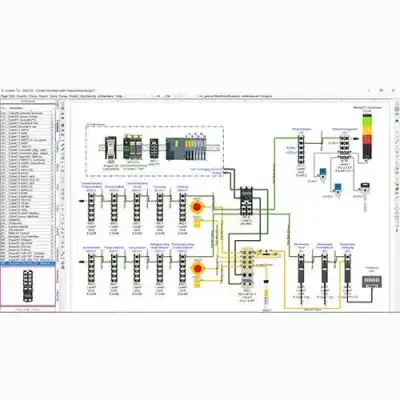
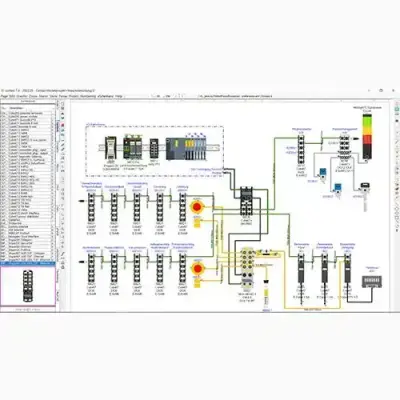
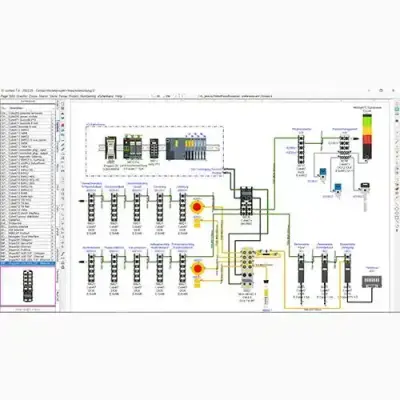
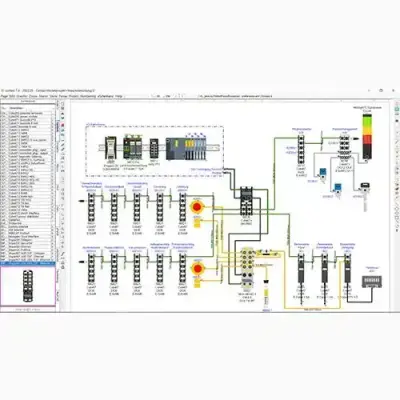
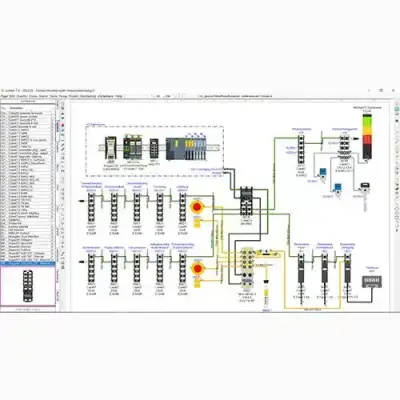
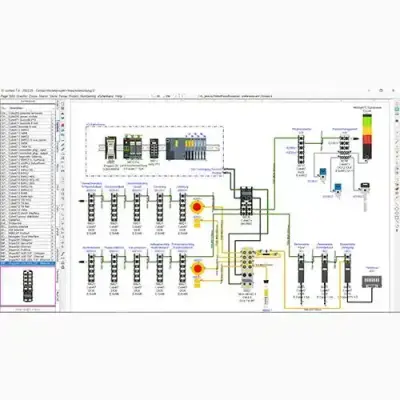
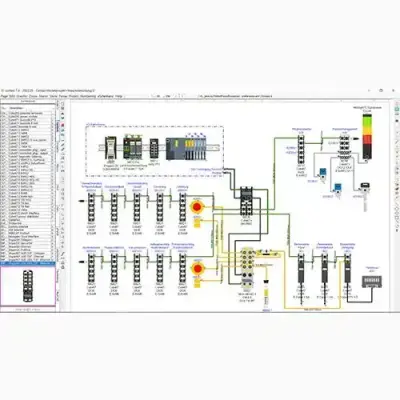
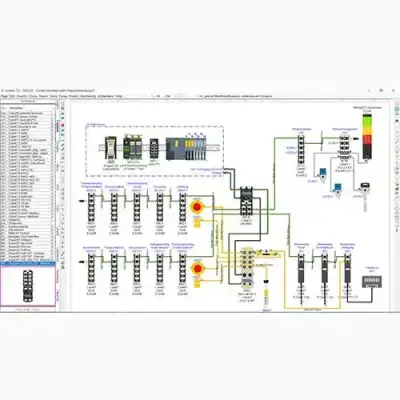
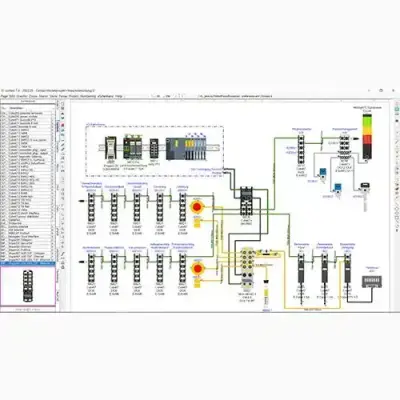
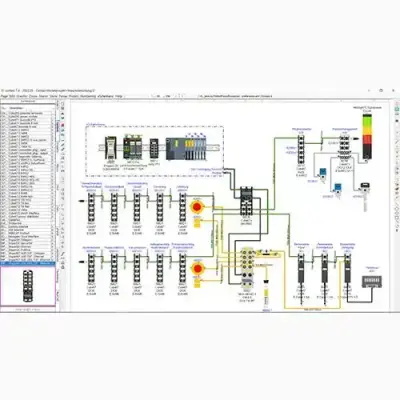
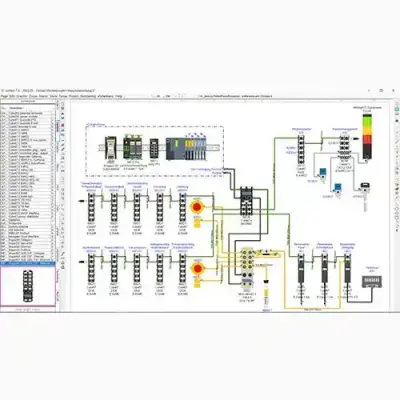
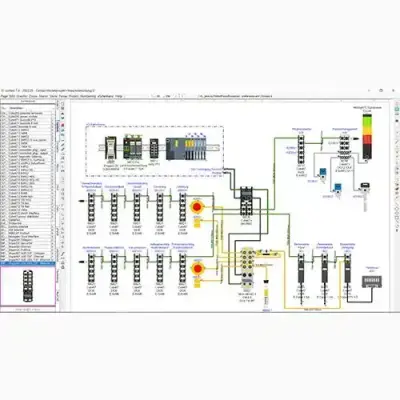
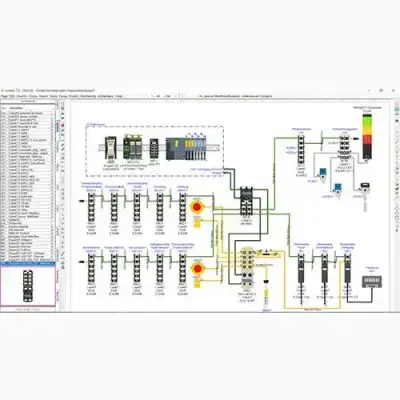
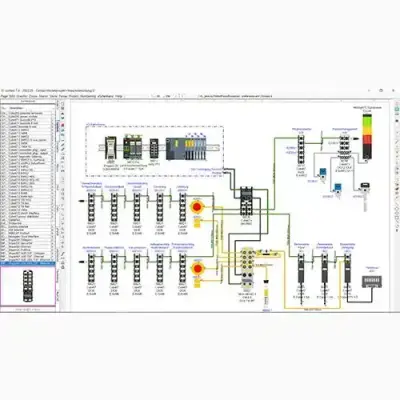
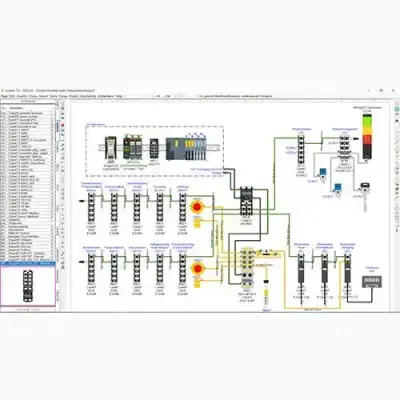
Electrical CAD software — more precisely ECAD (Electrical Computer-Aided Engineering) — is the engineering design environment used by control panel builders, machine builders, switchgear manufacturers and automation engineering companies to create circuit schematics, manage cable data, generate wiring lists and produce the complete documentation package required for panel manufacturing, CE marking and installation. Unlike general-purpose CAD tools (AutoCAD, SolidWorks) which require electrical symbols and reports to be created manually, dedicated ECAD software contains schematic-specific intelligence: auto-connection logic that automatically routes wire between components, real-time cross-referencing that keeps every document consistent as changes are made, and automated report generation that produces part lists, terminal connection plans, cable plans and PLC I/O cross-references from the schematic data without manual extraction.
The productivity difference between general CAD and dedicated ECAD is substantial and documented: panel design firms that switch from general CAD to EPLAN Electric P8 report productivity increases of 70% or more, driven by automation of the repetitive tasks — wire numbering, cross-referencing, BOM compilation — that consume the majority of a panel draughtsman's working day. DAS Company supplies and implements Cofaso (authorised implementation partner) and EPLAN Electric P8 for Eastern European panel builders, machine manufacturers and engineering companies seeking to reduce panel engineering time, eliminate documentation errors and standardise their engineering workflow.
The electrical engineering documentation for a mid-size motor control centre panel — 50 circuits, 300 components, 500 wire connections — requires the following documentation set: multi-line circuit schematics (typically 40–80 pages), terminal connection diagrams, cable plan with core-level detail, device list with article numbers and manufacturers, part list for procurement, wiring list for panel assembly, and PLC I/O assignment table. In a general CAD environment, every document is created independently — the draughtsman draws each schematic page, manually enters component data, manually creates the terminal list and manually compiles the BOM. A change to a wire number on page 3 requires manual updates on every downstream document that references it. This approach is slow, expensive and systematically error-prone: the BOM submitted to purchasing contains errors because it was compiled before the last schematic revision; the terminal list sent to the panel assembler differs from the as-built drawing because the late engineering change was not propagated through all documents.
Dedicated ECAD eliminates these problems by maintaining a single underlying engineering database — the schematic is the database, and every document (BOM, terminal plan, wiring list, cable plan) is a generated report from that database. Change a wire number in the schematic: the terminal connection plan, wiring list and cable plan all update automatically at the next report generation. Add a component to the schematic: the device list and part list update instantly. Delete a connection: the BOM quantity adjusts without manual editing. The engineering team works in the schematic; the documentation produces itself.
Cofaso is a cutting-edge electrical CAE (Computer Aided Engineering) solution that leverages a parameter-driven approach to ensure maximum consistency across control panel design and power distribution projects . DAS Company is an authorised Cofaso implementation partner — one of Cofaso's regional engineering partners responsible for software supply, implementation, component library setup and engineer training in Eastern Europe.
The cofaso eSchematic module automates the generation of 3-line (multi-line) circuit schematics — the engineering core that makes Cofaso distinctive in the electrical CAD market. Where EPLAN and AutoCAD Electrical require the engineer to manually place and connect symbols in the schematic, cofaso eSchematic generates 3-line schematics automatically from component configuration and connection data — the engineer defines what the circuit does, and eSchematic draws it. For panel builders and machine manufacturers building series panels with standardised circuits (motor starters, safety circuits, drive panels), eSchematic automation reduces schematic creation time from hours to minutes per circuit type, with consistent, standards-compliant output that eliminates the individual draughtsman variations that accumulate in manually drawn panel documentation.
Cofaso generates the complete documentation set automatically from the schematic database: part list (all components with article numbers and quantities, ready for procurement), purchase order list (procurement-ready BOM sorted by manufacturer), device list (all symbols and devices with designations and manufacturer data), wiring list (all wire numbers and connections inside the panel), cable plan (cable technical data and core-level connections), terminal connection plan (terminal strip to field connections for installation), and device-end-terminal/PLC plan (wiring from devices to terminal strips and PLC I/O modules). All reports are generated at the push of a button from the current schematic — there is no separate document to maintain and no risk of inconsistency between the schematic and its derived documents.
Cofaso supports standard data exchange formats — XML, EXF, DWG, and DXF for seamless integration with other CAx systems, and EDZ, EMA, EMS, and ZW5 file formats of EPLAN Software — enabling Cofaso users to exchange project data with clients and partners using EPLAN without reformatting. The built-in intelligent article number search and manufacturer macro libraries (components from Phoenix Contact, WAGO, Siemens, ABB, Schneider Electric and other major brands with pre-configured schematic symbols and article data) eliminate manual component data entry for standard catalogue items. Cofaso's global customer base includes Mercedes-Benz Türk (bus and truck manufacturing, Istanbul and Aksaray plants), Erdemir (OYAK Group integrated flat steel production), Murrelektronik and Chemgineering — confirming Cofaso's capability for complex industrial and manufacturing engineering documentation at enterprise scale.
EPLAN Electric P8 is the global market leader in dedicated electrical engineering software — providing leading software that enables machine and panel builders to design automation and power systems more efficiently, with access to over 2.3 million static components and 4 million configurable components through the EPLAN Data Portal . EPLAN Electric P8 supports multiple engineering methodologies — manual symbol placement for full design control, template-based design for standardised circuit blocks, and macro-based variant management for multi-option machine configurations — making it applicable to the complete range of panel engineering complexity from simple distribution boards to large multi-bay switchgear assemblies.
EPLAN's automatic cross-referencing and live consistency checking mean that as the engineer draws the schematic, EPLAN simultaneously validates wire connections, flags missing terminal assignments, identifies component reference conflicts and updates all cross-references in real time — catching the errors that manual drawing and post-processing checks miss until the panel is assembled. EPLAN's PLC data management allows PLC hardware configuration (from Siemens TIA Portal, Rockwell Studio 5000, Omron Sysmac Studio and other platforms) to be imported directly into the schematic — assigning PLC I/O addresses to field device connections and generating the I/O assignment tables that commissioning engineers need without manual data re-entry between the PLC programming tool and the ECAD system. EPLAN integrates with Rittal's ePLAN Pro Panel 3D cabinet layout software — enabling the 2D schematic and the 3D panel layout to share the same component database, automatically positioning components in the 3D cabinet and calculating cable lengths from the 3D routing paths for accurate cable schedule generation.
Electrical engineering documentation produced for CE-marked machine panels (IEC 61439, Machinery Directive 2006/42/EC) and for international projects must comply with applicable standards for drawing symbols, reference designation systems, terminal labelling and document structure. Cofaso supports IEC 60617 (graphical symbols for diagrams), IEC 81346 (reference designation for industrial systems), DIN EN standards for German and European market documentation, and UL 508A for North American panel documentation — covering the standards used by most European and export market panel and machine documentation requirements. EPLAN Electric P8 supports the same standards plus additional national variants (GOST for Eastern Europe and CIS markets, JIS for Japanese market documentation, GB/T for Chinese market projects) through its standards database — enabling engineering companies working across multiple markets to produce compliant documentation for each without separate software packages.
Both Cofaso and EPLAN Electric P8 are professional ECAD platforms that address the same core requirement — faster, more accurate electrical engineering documentation — but they approach the problem differently and suit different user profiles. Cofaso is distinguished by its eSchematic automated 3-line schematic generation, which is uniquely valuable for series panel production and standardised circuit applications; its parameter-driven architecture produces consistent, standards-compliant documentation with less manual draughting input, and its lower entry cost makes it accessible to smaller panel builders and engineering consultancies. EPLAN Electric P8 is the established market leader with the deepest feature set, the largest component data library (EPLAN Data Portal), the widest integration ecosystem (Rittal, Siemens, Rockwell and 200+ software and ERP integrations) and the longest track record in large panel building and switchgear manufacturing; it is the standard specification in major automotive, industrial and infrastructure projects where the client specifies EPLAN as the mandatory documentation platform.
For engineering organisations currently using general AutoCAD or manual drawing methods, either platform represents a transformative productivity improvement — the choice between them is primarily determined by the complexity of the panel applications, the size of the engineering team, the budget for software investment and whether clients specify a particular platform. DAS Company's engineering team provides an honest evaluation of both platforms against the specific requirements of your engineering operation — without bias toward either product — and implements the selected platform with component library setup, standard template creation and engineer training from our Bulgaria engineering base.
An electrical CAD software licence without implementation support provides the tool but not the productivity gain — ECAD software requires configuration before it delivers value: component libraries must be populated with the specific manufacturers and article numbers the engineering team uses, standard circuit templates and macros must be created for the repetitive circuit types in the company's panel production, drawing frame templates must be set up with the company's title block format and project numbering system, and engineers must be trained to use the automation features rather than replicating their manual drawing habits in the new tool. Without this setup, engineers default to using ECAD as an expensive drawing tool rather than a productivity system.
DAS Company's Cofaso and EPLAN implementation service covers the complete setup: component library configuration with article data for Phoenix Contact, WAGO, Siemens, ABB, Schneider Electric, Klemsan and other brands from DAS Company's hardware portfolio; standard circuit macro creation for motor starter, drive panel, safety circuit and PLC I/O panel circuit types commonly used by the engineering team; drawing frame and project template setup matching the company's document format; engineer training (typically 2–3 days on-site or remote) covering schematic creation, report generation and BOM export; and ongoing support for questions and platform updates after go-live.
Control panel builders are the primary ECAD user — companies building motor control centres, machine panels, distribution boards and process automation panels for industrial clients where complete engineering documentation (schematics, BOM, terminal plans) is a contractual deliverable alongside the physical panel. Machine builders and OEM manufacturers use ECAD for the electrical documentation of their machine designs — the schematic that documents the machine's complete electrical system, serves as the maintenance reference for the installed base and satisfies the CE marking technical file requirements under the Machinery Directive. System integrators building automation systems for industrial clients use ECAD to document the control architecture — PLC I/O assignments, network topology, field instrument connections — producing the commissioning and handover documentation that becomes the facility's permanent engineering record. Engineering consultancies specifying and documenting electrical systems for large industrial and infrastructure projects use ECAD to produce tender documentation, as-built records and design packages for contractor submission.
Contact DAS Company's engineering team for Cofaso and EPLAN Electric P8 licence pricing, a platform demonstration using your panel type as the example project, ROI calculation based on your current panel engineering volumes, and implementation quotation for Eastern European engineering organisations.