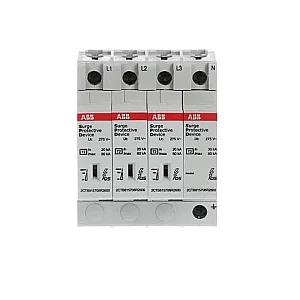
Overvoltage protection — formally Surge Protective Devices (SPDs) under IEC 61643-11 — defends electrical installations and connected equipment from transient overvoltages caused by lightning strikes (direct and induced) and by switching events on the power network (capacitor bank switching, motor starts, fault clearance and utility transformer operations). Where the passive lightning protection category covers the structure-level external protection that prevents physical building damage from direct strikes, the overvoltage protection category covers the electrical installation internal protection that prevents equipment damage from the high-voltage transients that lightning and switching events induce on the building's electrical wiring — preserving PLCs, SCADA hardware, drives, IT equipment, telecommunications and electronics that are sensitive to even brief overvoltage events well below the building structural damage threshold.
IEC 61643-11 — the international standard for low-voltage surge protective devices — defines three SPD types matched to three installation locations and three surge energy levels: Type 1 (Class I) at the service entrance for direct lightning current; Type 2 (Class II) at distribution boards for induced surges; Type 3 (Class III) at the point-of-use for sensitive equipment final clamping. Type 1+2 combined SPDs integrate both Type 1 and Type 2 capability in a single DIN-rail device for compact installations. DAS Company supplies the complete SPD portfolio — DIN-rail mount, panel-mount and integrated solutions — from leading European manufacturers including ABB OVR, Siemens SENTRON 5SD7, DEHN DEHNguard, Phoenix Contact Trabtech and Mersen Surge-Trap, with CE marking and IEC 61643-11 type-test certification for installation across European member states.
Type 1 (Class I) SPDs are installed at the service entrance / main distribution board (MDB) as the first stage of protection — required where the building has an external lightning protection system (LPS) per IEC 62305 or where the electrical service is fed by overhead lines exposed to direct lightning. Type 1 SPDs are tested with the 10/350 µs impulse current waveform at Iimp ratings from 12.5 kA to 100 kA per pole — the test waveform that simulates direct lightning strike energy entering the building through the electrical service. The 10/350 µs waveform carries 10–20× more energy than the 8/20 µs waveform used for Type 2 testing — which is why a Type 2 cannot substitute for a Type 1 where direct lightning current is expected, and why Type 1 SPDs are necessarily more robust and cost more than Type 2 equivalents.
Type 1 SPDs typically combine MOV (Metal Oxide Varistor) elements with spark gap discharge technology — the spark gap handles the high-energy direct lightning pulse without the catastrophic MOV failure that pure-MOV designs would experience at Iimp ≥ 25 kA, while the MOV provides residual voltage clamping after spark gap conduction. Standard Type 1 configurations cover the four European earthing system arrangements: TN-S (4-pole: L1+L2+L3+N with separate N-PE protection), TT (3+1 configuration with N-PE protection appropriate for the TT system), TN-C (3-pole: L1+L2+L3 only — neutral is combined with PE upstream), and IT (3-pole: L-L protection for the floating-neutral IT system). Backup protection upstream of Type 1 SPDs is mandatory — typically 125A gG fuse or C-curve MCB for Type 1 installations, with the backup protection coordinated per IEC 61643-12 to ensure SPD failure does not cause an unsafe condition.
Type 2 (Class II) SPDs are installed at distribution boards as the standard surge protection layer — required in virtually all commercial and industrial installations even where Type 1 protection is not required at the service entrance. Type 2 SPDs are tested with the 8/20 µs impulse current waveform at In nominal discharge current 5–20 kA per pole and Imax maximum discharge current 20–80 kA per pole — the test waveform that represents induced lightning surges and the switching transients that occur on internal building wiring. Type 2 SPDs use MOV technology as the primary clamping element — providing reliable repetitive surge handling without the higher cost of Type 1 spark gap construction.
Type 2 selection prioritises four parameters: Uc (Maximum Continuous Operating Voltage) must exceed the system nominal voltage (typically Uc 275V or 320V for 230V systems with safety margin for utility voltage variation); In (Nominal discharge current) should be 20 kA for industrial applications and 10–15 kA for commercial; Up (Voltage protection level) determines the residual voltage the SPD lets through to the protected equipment, with lower Up values providing better protection (typical Up ≤ 1.5 kV for sensitive electronics); and pole configuration matched to the earthing system (TN-S 4-pole, TT 3+1, TN-C 3-pole, IT 3-pole). Replaceable pluggable modules are standard on modern Type 2 SPDs — the surge-absorbing MOV element is in a pluggable cartridge that can be replaced when the end-of-life indicator turns red, without removing the base from the DIN rail or disconnecting the cabling — significantly reducing maintenance time and downtime when SPD replacement is required after a high-energy surge event.
Type 3 (Class III) SPDs provide point-of-use protection for sensitive equipment — installed adjacent to or within the protected device. Type 3 SPDs are tested with the combined 1.2/50 µs voltage / 8/20 µs current waveform at lower energy levels than Type 2 — providing the final voltage clamping to typically Up ≤ 1.5 kV that ultra-sensitive equipment requires. Type 3 SPDs are required when the distance between the Type 2 SPD and the protected equipment exceeds 15 metres (where voltage can re-escalate along the cable between the Type 2 SPD and the equipment due to inductance) and for installations protecting medical imaging, laboratory instrumentation, precision automation and IT server equipment where the three-stage protection cascade is required by equipment manufacturer warranty conditions.
Common Type 3 form factors include plug-in socket SPDs (Schuko 230V socket with integrated SPD for plug-in electronics protection), DIN-rail Type 3 SPDs (panel-mount for installation within control panels and sub-distribution close to the protected equipment), and integrated SPDs (built into power strips, UPS units and dedicated equipment power supplies). For PLC control racks in packaging lines 25 metres from the sub-panel where Type 2 SPD is installed, Type 3 SPD adjacent to the PLC provides the final clamping that prevents the PLC I/O modules from damage during high-energy surge events.
Type 1+2 combined SPDs pass both IEC 61643-11 Class I and Class II tests simultaneously in a single DIN-rail device — providing direct lightning current protection (Iimp 12.5–25 kA typical) and induced surge protection (In 20 kA typical) from one unit. Type 1+2 combined SPDs are the appropriate specification when: panel space is insufficient for separate Type 1 + Type 2 devices in the main distribution board; distance between service entrance and first sub-board is under 10 metres — where separate Type 1 and Type 2 cascade coordination is physically impossible; or retrofitting an existing panel to full IEC 61643-11 compliance in one installation step. The cost advantage of Type 1+2 combined is significant — a single 4-pole combined SPD replaces two separate 4-pole devices (Type 1 + Type 2) plus the wiring and DIN-rail space between them.
The trade-off of Type 1+2 combined SPDs is limited maximum Iimp rating — typical Iimp for combined devices is 12.5–25 kA per pole, lower than the highest-rated dedicated Type 1 devices (up to 100 kA per pole for the most extreme exposure installations). For very high lightning exposure sites (LPL I per IEC 62305, more than 10 flashes per km² per year), a dedicated Type 1 with higher Iimp may still be required, with a separate Type 2 downstream. For standard LPL II/III applications — the typical commercial and industrial building exposure — Type 1+2 combined provides full compliance with simpler installation.
SPD specification requires understanding five core parameters defined in IEC 61643-11. Uc (Maximum Continuous Operating Voltage) — the maximum AC voltage the SPD can withstand continuously without degradation. Must exceed the system nominal voltage with safety margin (typical 275V Uc for 230V systems, 320V Uc for systems with utility voltage tolerance issues). In (Nominal Discharge Current) — the 8/20 µs current the SPD can divert repeatedly without degradation; the rated working surge capacity. Type 2 SPDs are specified by In rating (5, 10, 15, 20 kA per pole). Imax (Maximum Discharge Current) — the maximum 8/20 µs current the SPD can divert once without failing; the survival rating for an extreme single event. Typically 2–4× the In rating. Up (Voltage Protection Level) — the residual voltage the SPD lets through to the protected equipment when conducting at In. Lower Up is better protection; target Up ≤ 1.5 kV for sensitive electronics and Up ≤ 2.5 kV for general distribution. Iimp (Impulse Current) — Type 1 specific parameter for the 10/350 µs direct lightning current waveform. Typical Iimp 12.5–50 kA per pole for direct lightning current protection.
DC surge protective devices address the rapidly growing renewable energy and electric mobility infrastructure market — providing surge protection for solar photovoltaic (PV) systems, EV charging stations, battery energy storage systems (BESS) and DC microgrid installations where AC SPDs cannot be used because the protected circuit is DC. Solar PV DC SPDs cover voltage ratings from 600 V DC through 1500 V DC for current utility-scale PV inverter input voltages — installed at the PV array combiner box (Type 2 protecting against induced surges in the array DC cabling) and at the inverter DC input (final clamping before sensitive inverter electronics). PV-specific SPDs include thermal disconnect mechanisms designed for DC arc-suppression — critical because DC arcs do not self-extinguish like AC arcs and require active interruption to prevent SPD fire risk.
EV charging station SPDs protect the increasingly large installed base of AC and DC charging infrastructure — AC SPDs on the grid-side mains supply (typical Type 2 in the charging station distribution board) plus dedicated signal/data SPDs on the OCPP communication interface protecting the cellular modem, Ethernet uplink and RFID reader from surge-induced damage. BESS SPDs are an emerging category — battery energy storage systems combine high DC voltage (typically 600 V DC to 1500 V DC) with valuable battery pack hardware sensitive to overvoltage damage, requiring DC SPDs rated for the battery system voltage and integrated with the BMS for SPD status monitoring.
Comprehensive SPD protection requires signal and data line SPDs alongside power line SPDs — a surge entering an unprotected data port bypasses all upstream power SPDs and damages the connected equipment regardless of how well the power supply is protected. Ethernet SPDs (Cat 5e and Cat 6 protected, with PoE pass-through for PoE-powered devices) protect IT network equipment, IP cameras and PoE-powered access points. RS-485 SPDs protect Modbus RTU, PROFIBUS-DP, BACnet MS/TP and other industrial serial communications from surge-induced damage — typical installations include long-cable run sensor networks, building management system field bus and substation SCADA communications. Coaxial SPDs protect TV antenna, satellite dish, base station radio and CCTV camera coaxial cabling. 4–20 mA / 0–10 V analog signal SPDs protect process instrumentation against surges induced in long sensor cables. Telephone line SPDs protect PABX and analogue voice equipment.
SPD clamping elements use one of two primary technologies — or both in combination. MOV (Metal Oxide Varistor) elements provide fast response (typical 25 ns response time), excellent voltage clamping accuracy and repeatable surge handling for moderate energy levels — the standard technology for Type 2 SPDs and Type 1+2 combined units up to typical 25 kA Iimp. MOV elements degrade gradually with each surge event — repeated surges progressively reduce the MOV's clamping capability, eventually reaching the end-of-life condition where the MOV's leakage current at normal operating voltage exceeds the thermal disconnect threshold, triggering the SPD's end-of-life indicator. Spark gap (encapsulated air gap) technology provides much higher energy handling capability than MOV — the spark gap conducts only when voltage exceeds breakdown threshold, then carries the full surge current with very low residual voltage. Spark gaps do not degrade with surge events — they have effectively unlimited surge cycle life — but have slower response time (typical 100 ns) and higher residual voltage during conduction. Type 1 SPDs at 25 kA Iimp and above typically use spark gap discharge technology with downstream MOV for residual clamping — the combination provides the energy handling of spark gap and the clamping accuracy of MOV.
Multi-stage SPD installations require coordination per IEC 61643-12 — the standard ensures that successive SPDs (Type 1, then Type 2, then Type 3) operate correctly without one SPD bypassing the next stage. Coordination requires minimum cable distance between SPDs (typically 10 metres between Type 1 and Type 2, or installation of a decoupling inductor where the distance is shorter) — the cable inductance allows the Type 1 to clamp its share of the surge before the Type 2 sees the full surge magnitude. Without coordination, a Type 2 located too close to a Type 1 may fail prematurely because it sees surge magnitudes that exceed its rated capability. DAS Company's engineering team provides SPD coordination guidance based on the customer's installation cable layout — recommending decoupling inductors where required and confirming SPD type selection achieves IEC 61643-12 compliant coordination.
Modern SPDs include visual end-of-life indication — a colour window (typically green/red) showing the SPD status. Green indicates the SPD is functional and providing protection. Red indicates the SPD has failed and is no longer providing protection — the protected equipment is currently unprotected and the SPD requires immediate replacement. Many commercial-grade SPDs add a remote signalling contact (Form C dry contact rated typically 5–250 V AC, 1 A) — wired to the building management system or maintenance alarm panel to provide remote notification of SPD end-of-life status, eliminating the need for manual visual inspection of SPD status across distributed installations. Pluggable replaceable modules enable hot-swap replacement of the failed surge cartridge without removing the SPD base from the DIN rail or disconnecting the cabling — typically 30 seconds per module replacement versus 5–10 minutes for a complete SPD replacement.
DAS Company provides competitive B2B pricing for overvoltage protection across Europe. Product categories with available pricing include Type 1 SPDs (single-pole, 2-pole, 3-pole, 4-pole and 3+1 configurations for TN-S, TT, TN-C and IT systems), Type 2 SPDs (all pole configurations, In ratings 5/10/15/20 kA), Type 3 plug-in and DIN-rail point-of-use SPDs, Type 1+2 combined SPDs for compact service entrance installations, DC SPDs for solar PV (600/1000/1500 V DC), EV charging and BESS, signal and data line SPDs (Ethernet PoE, RS-485, coaxial, 4–20 mA, telephone), and replacement pluggable cartridges for installed SPD bases. Volume pricing is available for distribution board installer accounts, panel builder projects and infrastructure development supply. Contact our engineering team for SPD selection and coordination support with full project material lists.